Why Does Ni80Cr20 Heating Wire Have a Short Lifespan? 6 Common Causes Explained
Ni80Cr20 (also known as Nichrome 80/20) is one of the most widely used resistance heating alloys in industrial and commercial applications. At DLX, we supply this material to customers across multiple industries, and one recurring concern we hear is: “Why is the lifespan shorter than expected?”
This article breaks down the real reasons behind premature failure, explains key material parameters, compares performance factors, and helps you choose the right solution for your application.
Product Overview: What Is Ni80Cr20?
Ni80Cr20 is a nickel-chromium alloy composed of approximately 80% nickel and 20% chromium. It is designed for high-temperature resistance heating applications.
Key characteristics:
Excellent oxidation resistance
Stable resistivity at high temperatures
Good mechanical strength
Long service life under proper conditions
Typical working temperature:
Up to 1200°C (depending on environment and design)
However, despite these advantages, improper usage or mismatched specifications can significantly shorten its lifespan.
6 Common Reasons Why Ni80Cr20 Wire Fails Early
1. Overheating Beyond Design Limits
One of the most frequent causes is operating the wire above its recommended temperature.
What happens:
Accelerated oxidation
Grain growth and embrittlement
Reduced mechanical strength
In many real cases, customers push the wire beyond 1100°C continuously without realizing the long-term damage.
2. Incorrect Surface Load (W/cm²)
Surface load is a critical factor that many users overlook.
If the watt density is too high:
Heat cannot dissipate efficiently
Local hotspots form
Wire burns out quickly
This is especially common in compact heating designs.
3. Poor Installation or Coil Design
Improper spacing or uneven coiling can cause:
Uneven heat distribution
Local overheating
Mechanical stress points
For example:
Coils too tight → heat accumulation
Coils touching → short circuits or hotspots
4. Contaminated Operating Environment
Ni80Cr20 performs well in clean air, but certain environments reduce lifespan dramatically:
Sulfur-containing atmospheres
Reducing gases
Metal dust or contaminants
These conditions can:
Destroy the protective oxide layer
Cause rapid corrosion
5. Frequent Thermal Cycling
Repeated heating and cooling cycles lead to:
Thermal fatigue
Micro-cracks
Structural degradation
Applications with frequent ON/OFF cycles tend to see shorter service life compared to continuous operation systems.
6. Incorrect Material Selection
In some cases, Ni80Cr20 is simply not the best choice.
For example:
Extremely high temperatures → FeCrAl may perform better
Oxidizing + sulfur environment → alternative alloys needed
Choosing the wrong material leads to unavoidable failure, no matter how good the quality is.
Key Parameters That Affect Lifespan
Understanding these parameters helps you control performance:
Resistivity: ~1.09 μΩ·m
Melting Point: ~1400°C
Recommended Max Temperature: 1100–1200°C
Density: 8.4 g/cm³
Elongation: ≥20%
Among these, temperature and surface load have the biggest impact on lifespan.
Comparison Table: Ni80Cr20 vs Alternative Heating Alloys
| Parameter | Ni80Cr20 | FeCrAl Alloy | Ni60Cr15 |
|---|---|---|---|
| Max Temperature | 1200°C | 1350°C | 1100°C |
| Oxidation Resistance | Excellent | Very High | Good |
| Mechanical Strength | High | Medium | Medium |
| Cost Level | Medium-High | Lower | Medium |
| Lifespan Stability | Very Stable | High (at higher temp) | Moderate |
| Application Range | Wide | High-temp focus | General heating |
Conclusion:
Ni80Cr20 = best balance of stability and performance
FeCrAl = better for extreme temperatures
Ni60Cr15 = lower-cost alternative for moderate conditions
Real Application Scenarios
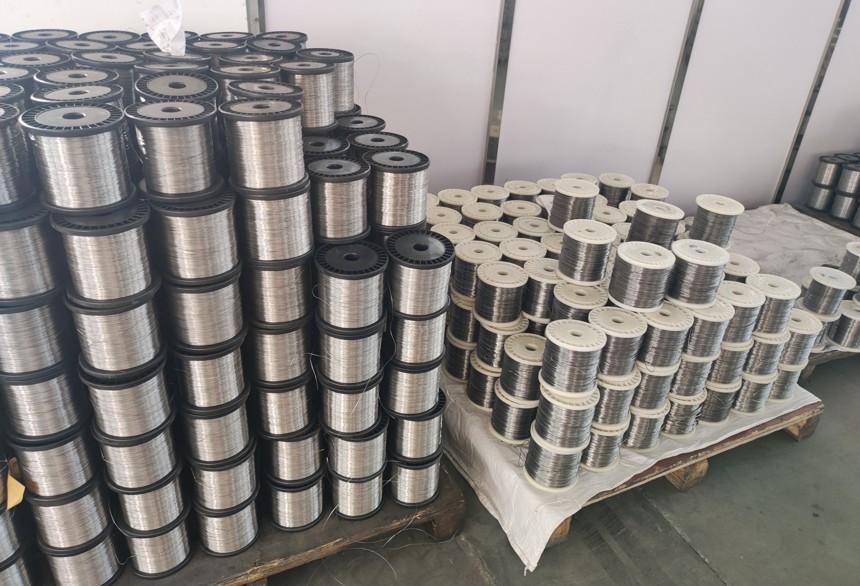
At DLX, we commonly see Ni80Cr20 used in:
Industrial furnaces
Heat treatment equipment
Electric heaters
Household appliances
Ceramic kilns
Real Case Example
A customer in Europe using Ni80Cr20 in a heat treatment furnace reported frequent wire breakage every 2–3 months.
After analysis, we found:
Surface load was too high
Coil spacing was insufficient
After redesign:
Lifespan increased to over 8 months
This shows that design and application matter as much as material quality.
What Makes a Reliable Supplier?
Not all Ni80Cr20 wires perform the same. Differences often come from:
Raw material purity
Melting process
Drawing precision
Heat treatment control
Typical Market Situation
Many suppliers focus on price competition:
Lower nickel content
Inconsistent diameter tolerance
Poor surface quality
This leads to unstable performance.
DLX Advantage: Why Our Ni80Cr20 Performs Better
At DLX, we focus on performance consistency, not just pricing.
Our strengths include:
Strict composition control
Stable resistivity across batches
Tight diameter tolerance (up to ±0.01mm)
Advanced annealing process
Customized production based on application
We don’t just supply wire — we help optimize your heating solution.
Industry Trends: Where Is Ni80Cr20 Heading?
The demand for Ni80Cr20 is evolving:
More precision applications (medical, electronics)
Higher efficiency heating systems
Increased demand for customized alloys
Customers are no longer just buying materials — they are looking for:
Longer lifespan
Better energy efficiency
Technical support
This is exactly where DLX positions itself.
FAQ (Frequently Asked Questions)
1. What is the typical lifespan of Ni80Cr20 wire?
It depends on temperature and load, but under proper conditions, it can last several months to over a year.
2. Can Ni80Cr20 be used above 1200°C?
It is not recommended for continuous use above 1200°C as it will significantly reduce lifespan.
3. Why does my wire break suddenly?
This is usually caused by overheating, poor coil design, or thermal fatigue.
4. Is Ni80Cr20 better than FeCrAl?
It depends on the application. Ni80Cr20 offers better stability, while FeCrAl handles higher temperatures.
5. How do I choose the right wire diameter?
It depends on your power requirements, voltage, and heating design. Proper calculation is essential.
6. Does surface condition affect performance?
Yes, a clean and smooth surface improves oxidation resistance and lifespan.
7. Can I customize Ni80Cr20 wire?
Yes, customization in diameter, resistance, and condition is possible.
8. What is the most important factor for lifespan?
Temperature control and surface load are the most critical factors.
Final Thoughts
Ni80Cr20 is a reliable and versatile heating material, but its lifespan depends heavily on how it is used. Most failures are not due to the material itself, but due to improper design, environment, or selection.
At DLX, we combine material expertise with real-world application experience to help customers achieve better performance and longer service life.
We can provide customized solutions based on your specific application.